

The EPC is no longer just paperwork. In 2026 it affects mortgages, resale value, rental yields and your long-term costs on the Costa Blanca. Here is what to check.
Energy Certificates Are Now a Major Buying Factor on the Costa Blanca in 2026
The Costa Blanca property market remains strong in 2026. Prices rose sharply in 2025 and are forecast to grow a more moderate but steady 4–8% this year, with premium northern locations still seeing the strongest demand from Dutch, German, French and Belgian buyers.
Yet one factor that barely registered with most international buyers two years ago has become a real decision driver: the Certificado de Eficiencia Energética — the Energy Performance Certificate, or EPC.
Why the EPC suddenly matters
Three changes have elevated its importance:
- Mortgage valuations now require a valid EPC. Banks and appraisers use the rating when calculating how much they will lend. A poor rating can reduce the valuation or complicate financing.
- Upcoming legal minimums. From 2030, properties generally need at least an E rating to be sold or rented. By 2033 the bar is expected to rise to D. Many older apartments and villas on the Costa Blanca still sit at F or G.
- Total cost of ownership is the new conversation. Buyers are no longer just comparing purchase prices. They are calculating electricity bills, future renovation obligations, and resale liquidity in five to ten years.
A low EPC rating is no longer a minor footnote — it is a line item that can cost tens of thousands of euros over the ownership period.
What the rating actually tells you
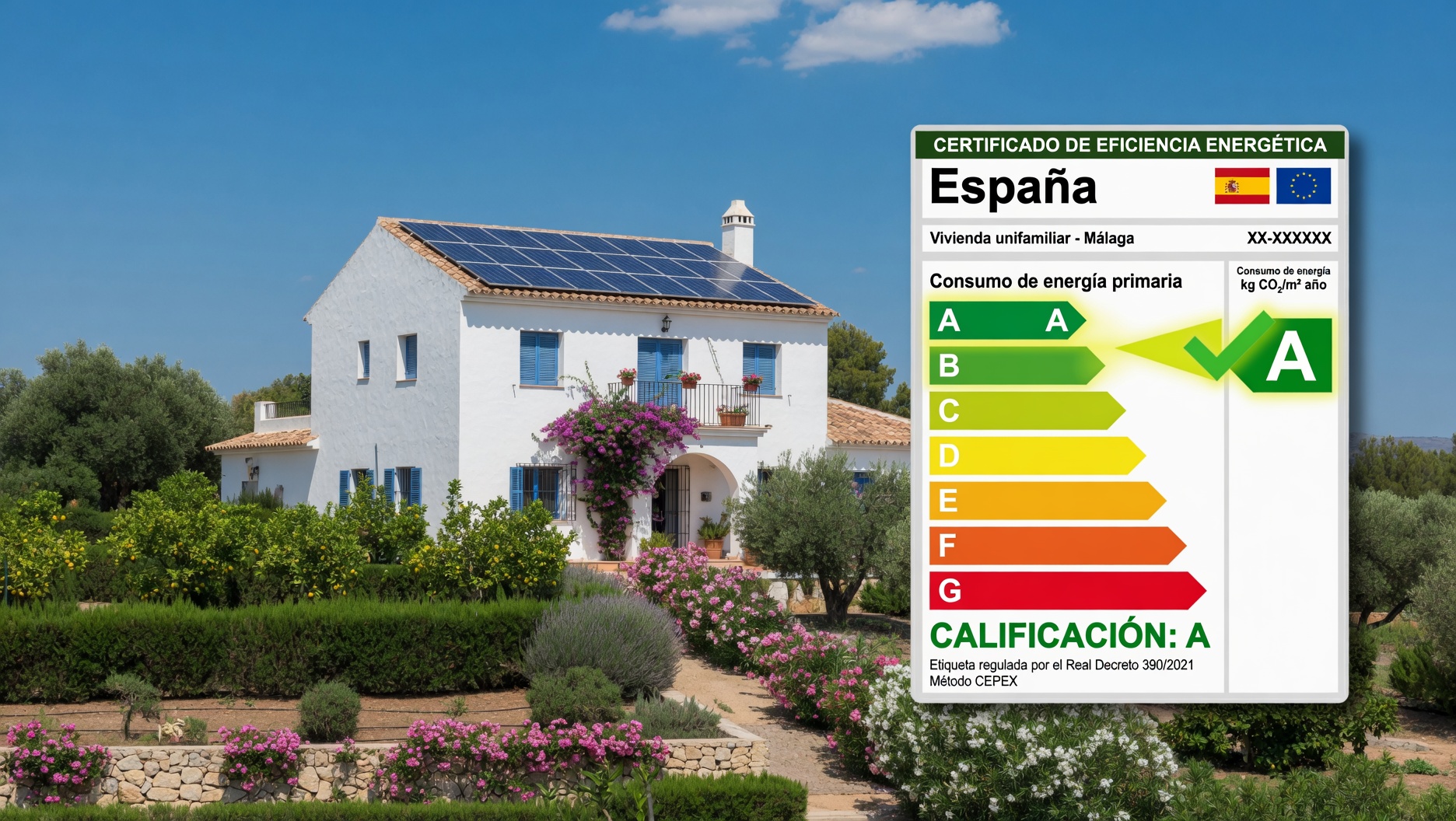
The certificate grades the property from A (very efficient) to G (very inefficient) based on estimated energy consumption for heating, cooling, hot water and lighting. On the Costa Blanca the Mediterranean climate helps, but many 1990s–2000s constructions were built with minimal insulation, single glazing and inefficient electric heating or old gas boilers.
A G-rated villa might consume two to three times more energy for air conditioning and heating than a modern C-rated equivalent of similar size.
Practical pre-purchase checklist
Before you fall in love with a property, ask for and review the EPC:
- Request the current certificate early — ideally before making an offer. It must be registered and less than ten years old (five years for G-rated properties).
- Look at the numeric consumption figure, not just the letter. Two E-rated properties can have very different real-world running costs.
- Check the recommendations section. The certificate lists the most cost-effective upgrades (new windows, roof insulation, solar panels, heat pump, etc.).
- Get realistic upgrade quotes. Window replacement on a typical 150 m² villa often runs €12,000–€25,000. Full envelope + HVAC upgrades can reach €40,000–€80,000 depending on size and scope.
- Factor in available support. Spain has extended national tax deductions and grants (up to €3,000 in many cases for qualifying works in 2026), and the Valencian Community offers additional regional incentives. These are time-limited and require pre- and post-works certificates.
- Understand the impact on rental potential. Properties with tourist licences (VUT) and good energy ratings are easier to market to quality tenants and often command stronger yields as short-term rental supply tightens due to new licensing restrictions.
- Consider new-build or recently renovated stock. Most post-2015 developments in Moraira, Altea Hills, Jávea and Benissa Costa already achieve B or C ratings and will remain compliant for decades.
North vs South — does location change the picture?
The North (Jávea, Moraira, Altea, Calpe, Benissa) has a higher proportion of newer and premium villas with better baseline efficiency, but many charming older townhouses still carry poor ratings. The South (Torrevieja, Orihuela Costa, Guardamar) has more 2000s apartment stock — some of it already renovated, much of it still inefficient. In both halves, the gap between best-in-class and average properties is widening in both price and liquidity.
Bottom line
In 2026 the smartest Costa Blanca buyers treat the energy certificate the same way they treat the Nota Simple or community debt certificate: as essential due diligence. A strong rating protects your financing, lowers running costs, future-proofs resale value and, in many cases, improves rental performance.
A weak rating is not necessarily a deal-breaker — but it must be priced in.
Speak with our team for a shortlist of properties where we have already reviewed the energy data alongside legal and rental-yield considerations. We will show you the real numbers, not just the brochure.
.jpeg)